Everyone thinks they’re great at communicating with their dog – and for the most part, they’re right! Dogs have evolved to be incredibly attuned to our emotions, and the average dog can learn up to 165 human words. However, humans have a more nuanced understanding of cause and effect than animals, which can lead to confusion. Today we’re taking a dive into canine psychology and animal behavior to help you better reinforce the behaviors you want – and not accidentally teach ones you don’t!
A Quick Summary
- There are four types of operant learning: positive reinforcement, negative reinforcement, punishment, and extinction
- Positive reinforcement and punishment both add something
- Negative reinforcement and extinction both take something away
- Most dog training focuses on positive reinforcement (which can be treats, praise, attention, physical touch, or various “life rewards”)
- When training, the reinforcement must follow shortly after the behavior – we’re talking within a few seconds!
- Take care not to accidentally reward unwanted behavior! Allowing bad habits only sometimes makes them stronger
A Closer Look
How Do Dogs Learn?
Broadly speaking, dogs (and other animals, including humans) learn by the results that they receive when they perform a certain action. Actions that are met with a desirable outcome are likely to be repeated; actions that are met with an undesirable outcome are avoided. When we train our dogs, we use this system to communicate what behaviors we want to see. We teach our dogs rules of engagement with ourselves, our homes, and our society through a mixture of reinforcement and punishment.
Reinforcement and Punishment
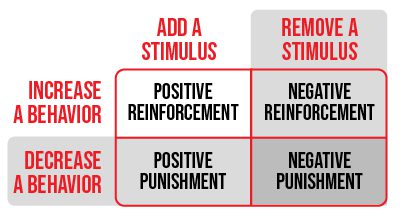
Reinforcement and punishment are concepts that are often misunderstood. This part can get a little bit technical, so bear with us! Reinforcement is a response to a behavior that encourages it. Punishment is a response that discourages the behavior. This can be further broken down into the following categories.
Positive Reinforcement
This is the most common form of dog training, and is generally the most effective for a puppy. Positive reinforcement is following a desired behavior with something good. For instance, if you tell your puppy to sit and then give them a treat, you have engaged in positive reinforcement.
Negative Reinforcement
In this case, “negative” does not mean “bad”, but “subtractive”. Negative reinforcement is the act of taking something away in order to increase the likelihood of a desired behavior. For example, a teenager’s parent could take away their cell phone (action) to encourage them to clean their room (behavior).
Positive Punishment (or simply “Punishment”)
Positive punishment is what most people mean when they discuss punishment. It is the addition of an aversive stimulus in response to a behavior. When you tell your dog “no!”, this is positive punishment (albeit a mild one).
Negative Punishment (or “Extinction”)
The final type of conditioning is Negative Punishment, in which you take something away in order to decrease the likelihood of a behavior. For instance, if you are trying to teach your puppy to walk on a loose leash and they begin to tug (behavior), you could stop walking (response). When your puppy is no longer pulling on the leash, you resume the walk. With practice, your puppy will stop tugging on the leash so that their desired outcome (the walk) can continue without interruption.
So How Does This Apply to Dog Training?
If you’ve made it this far you may be wondering, why does knowing these different types of conditioning matter? Understanding how animal learning works can help dog owners avoid common pitfalls of training.
Mistake #1: Teaching dogs what not to do instead of what to do
For dogs that do not have serious behavioral problems, research overwhelmingly supports that positive reinforcement is most effective. If your puppy jumps up on you and you simply shout “no!”, even if you have trained with your puppy on the meaning of the word “no”, they may not understand what you want them to do. “No” is a call to stop an action but gives no further direction. Instead, give your dog an incompatible command. In this case, telling your puppy “sit” or “place” redirects your puppy into a preferable response.
Mistake #2: Taking too long between action and response
In order to associate one with the other, the window between a behavior and a response is shockingly short. In fact, to begin with, this window may only be a few seconds! When you’re first starting to train a behavior, your puppy should be getting their reward right away. As the puppy becomes more familiar with the behavior, the delay between the two can grow. This is also another common issue with any type of aversive training; unless you are catching your dog actively doing the undesired behavior, the window has already closed. If you come home from work, find your dog has chewed your shoes to bits, and yell at them for it, not only is this confusing and frightening for the dog, but this has not taught them to not chew shoes; if they have learned anything at all, it will be not to leave pieces behind next time!
Mistake #3: Not understanding that reinforcement takes many forms
Treats and toys are not the only things that a dog finds rewarding. Reward can take many forms. When a dog knocks over a trash can and gorges themselves on the contents, they have just rewarded themselves. Reward can also take the form of being allowed in or out of an area, being given time to sniff at something on a walk, or being given the freedom to greet another person or dog. Moreover, dogs have evolved for millennia to find our affection rewarding. Simply touching them or making prolonged eye contact releases oxytocin (aka the “cuddle hormone”)!
Knowing what is reinforcing for a dog gives you opportunities to find non-food based rewards for good behavior. It also stops us from accidentally reinforcing bad behavior. Your first instinct if your dog growls at another dog may be to reassure them with a pat. Instead, you may inadvertently be telling them “yes, this is what we do when we see another dog, and here is your reward!”
Mistake #4: Letting your dog get away with things “only on occasion”
Here’s the scene: your puppy is staring up at you with the saddest eyes you have ever seen as you eat your dinner. Your rule is to never let your dog beg for food, but maybe… just this once… Bad news. Evidence supports that intermittent reward – that is, rewards that do not come every time a behavior is performed but at random intervals – create habits that are the hardest to break! Being consistent about the rules is the best way to keep these bad habits from forming in the first place.
Mistake #5: Never refreshing conditioning
If the best way to create a persistent habit is through intermittent reinforcement, does that mean that you should start randomly giving your puppy treats when they perform a behavior? The long version of this answer is complicated and involves factors such as how quickly a behavior is learned, frustration, and the fact that humans are bad at not subconsciously creating a pattern of reward. The short answer is… not necessarily.
If an action that received consistent rewards suddenly stops being rewarded, your puppy is less likely to go through the effort. After all, you would not keep working at your job if they suddenly stopped giving you a paycheck, would you? Similarly, your dog will start to forget the link between a behavior and a response if they have not been paired together for a long time.
Fortunately, this “paycheck” does not have to be limited to treats! As we noted earlier, every day is full of opportunities for “life rewards” for your dog. Tell your dog to sit before you serve them their dinner. Ask your puppy to drop a toy before resuming play. Scratch behind their ears, give verbal praise, and mix in some treats too on occasion. Your puppy loves you. They deserve to know that they’re a good dog.

Good dog!
✓ This article has been reviewed by Animal Kingdom’s expert team to ensure accuracy and reliable pet care guidance.