When picturing dog ownership, walking with your dog is probably one of the first things that comes to mind. After all, not only is walking great exercise for your dog (and for you!), but it’s also built-in bonding time. It’s truly a shame that for so many people, walks are a frustrating tug-of-war. It doesn’t have to be this way! By learning to communicate with your puppy and teaching them expectations, you can create more enjoyable walks for everyone. Here are some tips to teach your puppy good leash manners.
A Quick Overview
- A dog with good leash manners should be able to walk by their handler’s side without pulling or lunging
- A puppy just learning to walk on a leash should use a collar; harnesses are more secure and safer in long term
- Start training with your puppy in areas of low stimulation and work your way up
- When your puppy is paying attention to you while on leash, give them a reward
- If your puppy pulls on the leash, stop until they settle
- If you encounter something too exciting (such as a person or another dog) take a sharp turn in a different direction
- Stopping and turning around will mean your walks will take more time to cover less distance. Don’t give up! Consistency is key!
- Don’t forget to give your dog permission to sniff around every now and again
A Closer Look
What Constitutes Good Leash Manners?
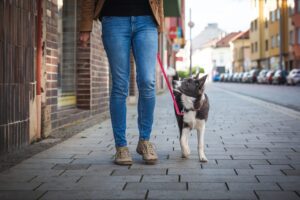
Before you start teaching your dog any behavior, make sure to have a clear idea of what you want. Going in with a nebulous notion of a “good” dog on a walk is a great way to end up confusing your dog through inconsistent reinforcement. Generally speaking, a dog with good leash manners will:
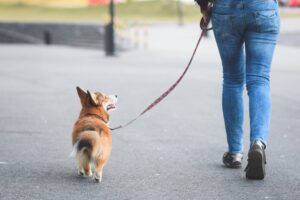
- Walk on a loose leash (that is, a leash that is not drawn taut with tension from them straining against it)
- Be responsive to the commands of their handler
- Greet people and other dogs neutrally unless given permission to interact
- Not lunge at people, dogs, bikes, cars, etc
Choose the Right Gear
Now that you have a clear idea of your expectations for your pup, your next step will be selecting tools for walking your dog. You’ll need plenty of high value treats and a pouch to put them in, waste bags to pick up poop, and preferably a water bottle. If you’re planning a longer walk and you have a small dog, consider bringing along a bag or backpack to carry them in if they get tired. Above all, you’ll need a leash and a way to attach it to your puppy.
Collar vs Harness
Collars and harnesses both have their benefits and drawbacks. For a young puppy that is just learning to walk on a leash, a collar may be more intuitive. Collars also take less time to put on or take off than a full harness, and have the added bonus of being an easy way to attach identification in case your puppy gets lost.
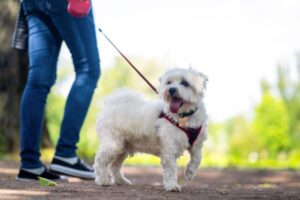
Harnesses, if appropriately sized, are more secure. They are also safer for a dog’s trachea if a dog tries to pull on the leash. This does come with a tradeoff, however; a harness allows a dog to pull more powerfully. If a puppy, especially one that will grow into a large dog, learns that they can get their way by simply overpowering their handler to drag them along, things can get out of hand. Front- and bottom-clip harnesses can help to reduce this risk.
In short, when it comes to choosing a collar or a harness, the answer may be… both! Teach your puppy to walk first using a collar and keep it on for identification purposes or quick jaunts outside. Expose your puppy early to a harness to help them get used to it and use it for longer, more involved walks once your puppy understands the basics.
Short Lead or Long Lead
While your puppy is learning to walk nicely on a leash, we recommend a standard 4- to 6- foot leash. For larger breeds, as they grow up their strides will naturally become longer, and they may prefer a leash with more length as they grow. Beyond all else, we can definitively say: do NOT use a retractable leash while you are trying to train your puppy in leash manners. Aside from it being impossible to teach loose-leash walking on a retractable leash, retractable leashes are thinner, less secure, and create a confounding factor of noise as the leash extends or retracts.
Consider Pre-Exercising Your Puppy
We know, it sounds counterintuitive – isn’t the whole point of going on a walk to exercise your dog? While that’s true, it’s also true that your puppy is going to be most responsive to training when they are not a furry ball of pent-up energy. We’re not suggesting running a marathon with your dog before starting your walk. Simply toss a ball around with a little bit of fetch or play some tug of war with your dog to help take the edge off of their energy before you begin.
Start Early, Start Small
Puppies who have not yet had all of their vaccinations should avoid walking in areas that are highly trafficked by dogs. This makes things a bit complicated when walking is precisely what you’re trying to teach. Never fear! Leash training can – and should – start in your own home. Getting your puppy comfortable with being on a leash is the first step. Once they are at ease with your walking gear, you can start training. As with most areas of training, start with a quiet environment with minimal distractions. Once your puppy has grasped the basics, you can move on to more exciting venues.
Reward Attention on You
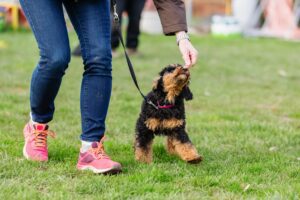
This step is very simple. If your puppy pays attention to you while on the leash when the leash is loose, give your puppy a high value treat. This includes walking toward you or making eye contact. You are ready to start walking! Cue them with a command (such as “let’s go” or “come on”) and take a few steps forward. If your puppy remains at your side, reward them with another treat. Your objective is to teach your puppy that while they may encounter exciting distractions, paying attention to you is always rewarding. You can also work with your puppy off the leash teaching them to pay attention to you and walk at your side with treats.
If your puppy has the opposite problem and they are paying too much attention to you (such as biting your hands or clothes), this may be a sign that the environment is overstimulating. Try again in a quieter area. If you did not exercise your puppy in advance, try that next time to burn off excessive energy. Conversely, remember also that puppies need a ton of sleep. If your puppy has not had a chance to rest in some time, consider putting them down for a nap. You would be surprised at how often a cranky, mouthy puppy wakes up as a sweet and gentle one!
Stopping Short
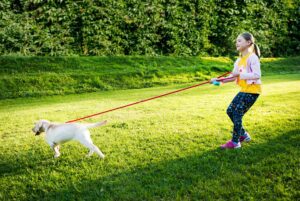
We’ve gone over rewarding your puppy if they’re paying attention to you. What happens if they don’t? If your puppy begins to pull on the leash, stop walking. Only resume walking when your puppy is once again by your side. If your puppy begins to pull again, repeat this. If your puppy remains walking loosely on the leash, reward their good behavior. Important: be sure that you are not inadvertently teaching your puppy the sequence of “pull, return, treat”. Only reward them after you have taken some steps forward with them by your side. (Interested in learning how to keep your puppy from learning the wrong thing? Take a deeper look into canine psychology with our blog post on how dogs learn.)
Turning Tail
This stop-and-go method of training only works when the distractions are relatively minor. Past a certain threshold of excitement, such seeing a person or another dog, simply staying still is not going to cut it. Instead, you’re going to abruptly stop and change directions. This decision is twofold. First, you’re once again reinforcing to your dog that they need to be paying attention to you for one of these sharp turns. Secondly, you’re removing them from interacting with stimuli that are too powerful for them to handle yet. As you and your puppy practice loose-leash walking, you can get closer to these more powerful distractions until you can pass them by without either of you batting an eyelash. Make sure to practice these abrupt changes even when there are no major distractions in the area. Keep your puppy on their toes!
Leave It!
Your leash exists as a tool for safety, not as a fishing line to reel in your puppy. There may come a time when you need to use it as that safety tool. Maybe your puppy is trying to eat trash or heading toward the street. Whenever these cases arise, you need to be able to instruct your dog to stop what they are doing and come to you. A solid recall is essential in times like these, which is a topic we shall be exploring more thoroughly in future blogs. Practicing the “drop it” and “leave it” commands in your home can also be very helpful.
We also highly recommend this video by Kikopup on Leash Pressure Games for Puppies. To briefly summarize, she demonstrates how to teach your puppy that pressure on the leash is a cue to return to your side rather than something to strain against. She does this by gently tugging on a puppy’s leash and then rewarding the puppy with a treat.
Set the goal of time OR Distance
All of this stopping and turning around will significantly impact how long it takes for you and your puppy to move from Point A to Point B. We recommend setting a goal of either time or distance when going on a walk with your puppy. You can start out with the goal to walk for 30 minutes, even if you can still see your house by the end of the session. On the other hand, you can decide to walk to the library even if it takes an hour. Setting these goals helps to fend off frustration and reduces the temptation to let them get away with bad behavior if you’re in a hurry.
Have Empathy With Your Dog
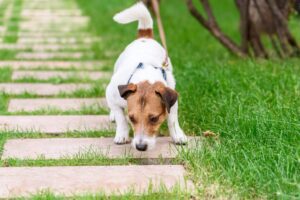
Above all, remember to have empathy with your dog. Dogs experience the world primarily through their sense of smell, and have the instincts to run around. As far as dogs are concerned, when we go on walks, their strange human friend insists on walking at an absolutely glacial pace and refuses to pay attention to anything interesting! This is why it is important to include built-in time for your puppy to sniff. From time to time, give them a command such as “go sniff!” and allow them to sniff to their heart’s content. It may get a bit boring for the humans, but your puppy is going to be a lot less desperate to pull toward interesting smells if they trust they will get the opportunity to explore them eventually.
By tying it to a command, you also teach your dog the expectations for when it is okay to sniff around and when they should be paying attention to you. Finally, this sort of use of their nose is also great mental exercise. Mental exercise can be just as tiring for your dog as physical exercise, and a tired dog is a happy dog. Once your puppy has mastered the art of loose-leash walking, you can even give dog-guided Sniffy Walks a try.
Yes, we know that the process of teaching your puppy leash manners can be a little tedious. Yes, you may look a little silly in front of your neighbors. Just remember that this is an investment in your mutual long-term well-being. With a little effort up front, you and your dog will have many years of joyous walks ahead of you. Happy adventuring!
✓ This article has been reviewed by Animal Kingdom’s expert team to ensure accuracy and reliable pet care guidance.